
 Uncategorized
The first time you step off a marked trail and into thick Belize jungle, the sound changes before anything else. Bird calls seem farther away, the air feels heavier, and suddenly the difference between a casual walk and a real jungle survival skills experience becomes very clear. This is where guided knowledge matters – not for drama, but because the jungle rewards awareness and punishes guesswork.
For many travelers, the appeal is obvious. You do not want a staged attraction or a crowded outing where you follow a line of people, snap a few photos, and head back to the van. You want to learn how this environment actually works. You want to understand how local guides read the forest, find direction under canopy, identify useful plants, and move safely through terrain that can shift from inviting to challenging in a few steps.
In Belize, that experience feels especially real because the inland landscape is not manufactured for tourism. It is alive, layered, and deeply tied to local knowledge. A good jungle outing here is not about pretending you are stranded. It is about learning the practical skills, decision-making, and respect for place that make jungle travel possible in the first place.
What a jungle survival skills experience really means
A true jungle survival skills experience is less about extreme scenarios and more about understanding priorities. In a tropical environment, your first concern is usually not hunting for food. It is orientation, water, weather, footing, and energy management. People who are new to jungle travel often imagine dramatic survival tactics. Experienced guides think first about staying calm, staying found, and making good choices early.
That distinction matters. The jungle is full of life, but it is also dense, humid, and sometimes deceptive. Distances feel different under canopy. Streams can help with navigation, but not always. A plant that looks harmless may not be useful at all. Even stopping in the wrong place can mean more insect exposure, more heat stress, or a harder route back out.
That is why the best experiences teach judgment, not just tricks. You may learn how to spot natural indicators, recognize shelter options, or identify basic plant uses, but the bigger lesson is how to observe before acting. In the jungle, patience is often more valuable than speed.
Why Belize is the right place for this kind of adventure
Belize offers a rare mix of accessibility and authenticity. You can reach rich inland jungle environments without needing an expedition-grade plan, yet once inside, the terrain still feels wild enough to demand respect. That makes it ideal for travelers who want a meaningful adventure without crossing into reckless territory.
The other advantage is local knowledge. Belize’s inland regions are shaped by generations of people who understand the forest through direct experience – not theory alone. A knowledgeable guide can explain which trees hold practical value, how seasonal changes affect movement, why certain areas attract wildlife, and what signs to notice underfoot or overhead. That local interpretation turns a walk into something much deeper.
This is also where a private, low-crowd setting makes a difference. In a busy group, survival-style learning becomes passive. You stop asking questions. You move at the pace of the crowd. In a quieter setting, there is room to pause, listen, inspect tracks, test techniques, and let the forest make an impression.
The skills travelers usually remember most
Navigation is often the first surprise. Most people rely so heavily on trails, signs, and phones that moving through jungle with intention feels like a new language. Under thick canopy, the usual visual cues are limited. A guide may show you how terrain, water flow, sun position, and vegetation patterns work together, but also where those clues can mislead you. Jungle navigation is never as simple as following one sign.
Water awareness is another major lesson. In tropical conditions, hydration becomes urgent quickly, yet not every water source is safe or practical. Travelers often come in thinking water is either available or not. In reality, the more useful question is whether it is accessible, reliable, and appropriate to use. Learning how guides assess water sources changes how people think about the environment around them.
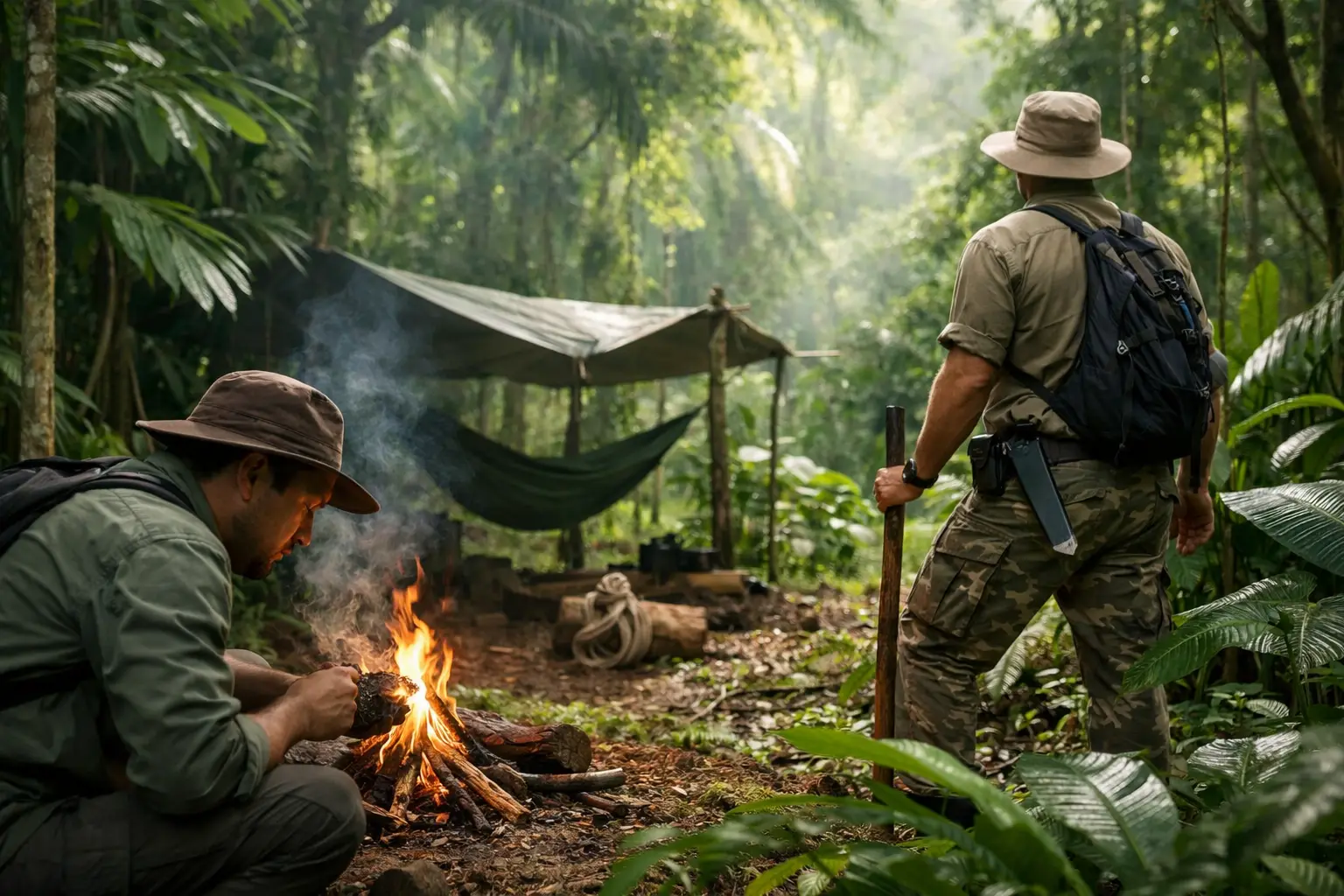
Then there is shelter and weather judgment. In the jungle, staying dry is not always realistic, but reducing exposure matters. The right place to stop, rest, or wait out rain can make a big difference in comfort and safety. This is not about building a dramatic movie-style camp. It is about recognizing terrain, drainage, falling hazards, and wind protection.
Plant knowledge tends to be the most memorable part for many guests. The jungle can look visually overwhelming at first, but over time certain species stand out for their texture, structure, or practical use. Some may help with cordage, some have traditional uses, and others are best appreciated from a distance. A guide’s role here is essential, because guessing wrong in the jungle is a poor strategy.
What makes guided learning better than going alone
There is a big difference between adventurous and unprepared. A jungle survival skills experience should feel immersive, but it should not depend on avoidable risk. Going with an experienced local guide gives you more than safety oversight. It gives you context.
Without that context, travelers often misread what they are seeing. They focus on the dramatic and miss the useful. They assume the jungle is chaotic when in fact it has patterns. A guide helps you understand why a route is chosen, why one plant matters and another does not, why animal signs are worth noticing, and when the smartest move is simply to slow down.
This also makes the day more enjoyable. You are free to pay attention instead of worrying about every decision. For couples, families, or small private groups, that balance is ideal. You still get the excitement of hands-on exploration, but with the reassurance that someone experienced is reading the environment with you.
For travelers who want that mix of immersion and support, Belize Inland Tours approaches inland adventure the way many guests prefer – personal, grounded, and away from the crowded feel of mass-market excursions.
Jungle survival skills experience for different kinds of travelers
Not everyone comes to Belize wanting the same level of challenge, and that is a good thing. A family with older kids may want a lighter introduction focused on awareness, wildlife signs, and practical bushcraft. A couple interested in nature and culture may prefer a deeper interpretive experience that connects forest knowledge with local history and traditional uses. More adventure-oriented travelers may want a longer, more physically active outing with route-finding and hands-on practice.
The best version depends on your pace, comfort level, and what you hope to take away from the day. If you want to feel capable in the environment, the experience should include participation. If you want a broader understanding of Belize’s inland ecosystems, interpretation may matter more than technique. Neither approach is better. It depends on whether you are chasing skill, connection, or a bit of both.
What to expect physically and mentally
A jungle outing can be more demanding than it looks on paper. Heat, humidity, uneven ground, roots, mud, and constant sensory input all add up. You do not need to be an elite athlete, but you do need a basic comfort with walking outdoors and listening closely to your guide.
Mentally, the adjustment is just as interesting. The jungle asks you to pay attention in a different way. You start noticing layers – insect sounds, broken branches, changes in soil, the way light filters through certain sections. Time feels different there. That is part of the appeal. A good experience slows you down enough to notice what most visitors miss.
It also tends to leave a lasting impression because the lessons feel earned. You are not reading signs in a visitor center. You are standing in the environment itself, learning why small decisions matter.
How to get the most from the experience
Come ready to listen more than perform. The goal is not to prove toughness. It is to learn how the jungle works from people who know it well. Wear practical clothing, expect to sweat, and treat curiosity as your best gear.
It also helps to arrive with the right mindset. A jungle survival skills experience is not a stunt. It is an invitation to see Belize more honestly – through its terrain, its rhythms, and the local knowledge that makes real exploration possible. If that is the kind of adventure you are after, the jungle will give you plenty to think about long after you step back onto the road.

