
 Uncategorized
A howler monkey does not need to be close to make an impression. In the Belizean jungle, its call can roll through the canopy before breakfast, deep enough to stop a conversation mid-sentence. That is the appeal of Belize wildlife: the experience is not limited to a checklist or a distant view from a vehicle. With patience, quiet movement, and the right habitat, the forest begins to show itself.
Belize is small on the map, but its inland landscapes hold remarkable variety. Broadleaf rainforest, river corridors, limestone caves, pine savannas, wetlands, and farm edges create different homes for animals within a relatively short drive. Travelers who slow down and spend time on quieter trails often see more than those moving quickly between major stops.
Belize Wildlife Begins With Habitat, Not Luck
Wildlife sightings are never guaranteed, and any guide who promises a jaguar on demand is not setting honest expectations. What experienced local guides can do is read the conditions: recent rain, fruiting trees, water sources, tracks on a trail, bird calls, and the time of day. Those details turn a walk in the jungle into a more attentive experience.
The Cayo District and central Belize are especially rewarding for inland travelers because forest, rivers, caves, and protected areas sit close together. Around St. Herman’s Blue Hole National Park, the mix of mature forest and limestone terrain supports a busy living landscape. You may hear birds before you see them, notice butterflies gathering near damp ground, or find fresh animal tracks where the trail meets a quiet waterway.
Early morning is often the strongest time for birds and mammals. Late afternoon can be equally productive as the air cools and daytime activity shifts. Night brings another world entirely, though it calls for a careful approach, proper lighting, and respect for the animals that rely on darkness.
The Animals Many Visitors Hope to See
Belize is home to iconic species, but the most memorable encounter is not always with the largest animal. A tiny hummingbird holding still for a moment, a lizard disappearing into leaf litter, or a troop of monkeys moving through the canopy can stay with you just as long.
Howler monkeys and spider monkeys
Black howler monkeys are among the most recognizable animals in Belize. Their powerful calls carry far through the forest, especially in the early hours, and they are often easier to hear than to spot. Look high into the canopy for dark shapes feeding or resting among the branches.
Spider monkeys are more active and agile, moving quickly through the treetops with long limbs and expressive tails. Seeing either species depends on the forest area, season, and how quietly a group moves. A private outing has an advantage here: there is no need to keep pace with a large group, and there is time to pause when the canopy starts to rustle.
Birds that reward patience
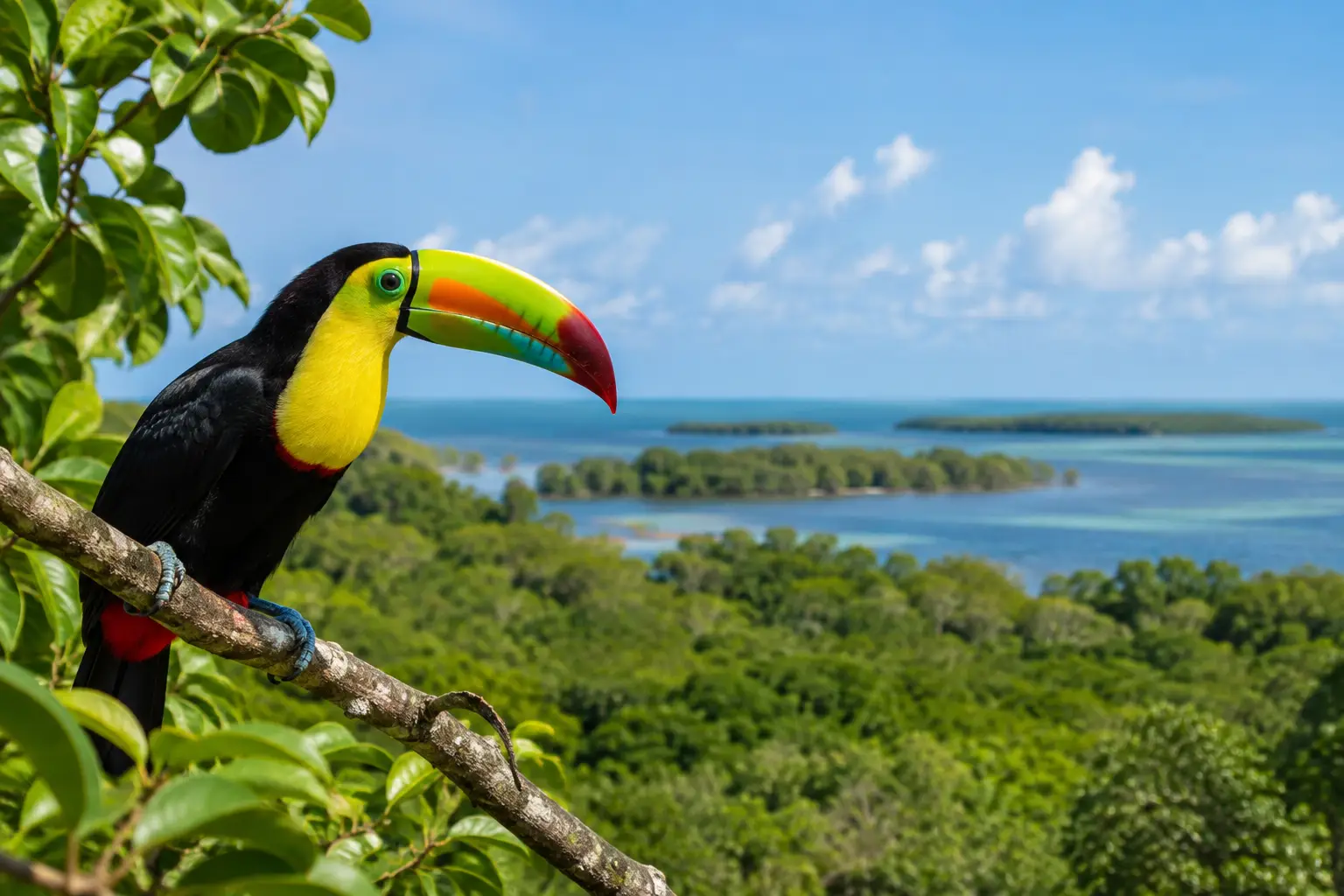
Belize is a serious destination for bird watchers, whether you travel with binoculars and a species list or simply enjoy the color and sound of the forest. Keel-billed toucans, with their oversized rainbow bills, are a favorite sighting. Motmots, trogons, woodpeckers, parrots, kingfishers, and raptors add variety across different habitats.
Birding is one area where expectations should match the setting. Dense jungle can make a forest feel full of birds while offering only brief views. Open clearings, riverbanks, forest edges, and early-morning trails may provide better visibility. A guide who recognizes calls can help visitors notice species they would otherwise walk past without realizing it.
Tapirs, peccaries, and the cats of Belize
The Baird’s tapir is Belize’s national animal and one of the most unusual mammals in Central America. It is large, shy, and usually most active in low-light hours. A direct sighting is special, but tracks, feeding signs, or stories from areas where tapirs regularly travel can still give visitors a better sense of the forest around them.
Collared peccaries, similar in appearance to small wild pigs, may travel in groups and can sometimes be seen or heard moving through brush. White-tailed deer, coatis, agoutis, and other smaller mammals are also possible sightings on quieter inland routes.
Belize is famous for its wild cats, including jaguars, pumas, ocelots, and margays. Jaguars are present in protected forest, but they are naturally elusive and should be treated as a rare privilege rather than a tour expectation. Their presence matters even when they remain unseen. A healthy predator population is one sign that large areas of forest still function as connected habitat.
Reptiles, amphibians, and small forest life
Warm, wet conditions support an impressive range of reptiles and amphibians. Iguanas often appear along sunny edges, while smaller lizards move almost unnoticed through low vegetation. Crocodiles may be found in appropriate wetland and river habitats, but they should always be observed from a safe distance.
After rain, the forest becomes especially alive with frogs, insects, and other small creatures. These are easy to overlook when travelers are focused on larger animals, yet they reveal how much activity exists close to the ground. A good jungle walk includes time to look down, up, and all around.
Why Quiet Travel Makes a Difference
Crowds change wildlife behavior. Loud voices, constant movement, bright flashes, and people pushing toward an animal can shorten an encounter or prevent one from happening at all. The goal is not to chase wildlife. It is to enter its habitat with enough care that natural behavior can continue.
Private guided experiences are well suited to this kind of travel. The pace can match the group, whether that means stopping for bird calls, taking a slower family-friendly trail, or giving an experienced photographer time to work with changing light. Belize Inland Tours builds inland outings around this more personal rhythm, with local guidance that helps guests understand what they are seeing without turning the forest into a spectacle.
There are trade-offs. Popular locations can offer easier infrastructure and predictable access, which may be the right choice for travelers with limited mobility or a tight schedule. Quieter places may require a little more patience, uneven ground, humidity, and a willingness to accept that nature sets the agenda. For many visitors, that is exactly what makes the experience feel real.
How to Watch Wildlife Respectfully
The best wildlife encounters leave no stress behind. Keep voices low, stay on established trails, and let animals choose their distance. Never feed wildlife, even when an animal appears comfortable around people. Food changes behavior, can make animals dependent on visitors, and may create risks for both animals and guests.
Flash photography is best avoided, particularly around nocturnal animals and birds. If you bring binoculars, use them to observe instead of moving closer. On a guided night walk, use red light when appropriate and follow your guide’s direction around snakes, insects, and uneven terrain.
Clothing also matters more than many travelers expect. Neutral colors are less distracting than bright patterns, while long sleeves, insect repellent, closed-toe shoes, and a refillable water bottle make jungle time more comfortable. Rain gear is useful in Belize’s wetter months, but a brief shower can also bring welcome activity to the forest.
Plan for the Season You Have, Not the One You Imagine
Belize has wildlife year-round, but conditions shift with the seasons. The drier months can make trails easier and may concentrate animals near dependable water. The greener, wetter months bring lush vegetation, active amphibians, dramatic clouds, and a forest that feels intensely alive. Visibility can be more challenging when foliage is thick, so the best season depends on what matters most to you.
Bird activity also changes as migratory species pass through, while flowering and fruiting cycles influence where animals feed. Rather than planning around one promised animal, choose an experience that gives you time in a healthy habitat and arrive curious about what the day offers.
Bring the same patience you would bring to a quiet conversation. Listen before you speak, look past the obvious, and give the jungle time to respond. In Belize, the moment you stop trying to make wildlife appear is often the moment the forest lets you notice it.
