
 Uncategorized
The moment you stand in front of a Maya site in the Belize jungle, the country starts to feel different. It stops being just a beach destination with great weather and turns into something deeper. The best Belize cultural heritage experiences do that – they give context to the landscape, connect you to the people who shaped it, and make every cave, trail, village, and river feel part of a longer story.
For travelers who want more than a quick photo stop, Belize offers a rare mix of living culture and ancient history in a compact, easy-to-reach destination. You can visit ceremonial centers built by the Maya, hear how traditional foods are still prepared today, learn why certain plants matter in local life, and spend time inland where culture is not staged for crowds. That is usually where the experience becomes more personal and more memorable.
What makes Belize cultural heritage experiences worth seeking out
Some destinations separate history from everyday life. Belize does not. Here, heritage is not limited to museum displays or reconstructed villages. It is present in the languages people speak, the foods served at family-run stops, the farming traditions still used in rural communities, and the respect local guides bring to caves, rivers, and archaeological sites.
That matters because cultural travel can feel shallow when it is rushed or overproduced. In Belize, the strongest experiences tend to happen when you slow down and let the setting do some of the work. A quiet Maya ruin in the forest teaches something different from a crowded landmark. A conversation with a local guide often tells you more than a signboard ever could. The value is not only in what you see, but in how you are introduced to it.
For many visitors, inland Belize is where that shift happens. Away from high-volume tourism, the country feels more grounded. You begin to notice how culture, ecology, and history are tied together. The jungle is not just scenery. The caves were not just adventure sites. The ruins were not isolated monuments. Each one sits inside a much bigger cultural landscape.
Ancient Maya heritage is only the beginning
Belize is home to some of the most significant Maya archaeological sites in the region, and visiting them is often the starting point for understanding the country. Places such as Xunantunich, Caracol, Cahal Pech, and Lamanai each offer a different window into Maya civilization. Some impress with scale. Others feel more intimate and easier to absorb, especially if you prefer space to think and ask questions.
What makes these visits meaningful is interpretation. A temple is more than a stone structure once you understand how it was used, what the plaza layout reveals about society, or why the location mattered politically and spiritually. Good guiding changes the entire experience. Instead of seeing ruins as relics, you start to see them as evidence of a sophisticated world that still shapes Belize today.
That said, not every traveler wants the same type of site visit. Families with younger kids may connect better with a shorter, more accessible ruin tour. History-focused travelers may prefer a larger site and more time for detail. If you enjoy active travel, pairing a Maya site with cave exploration or a jungle hike can make the day feel more complete without losing the cultural side of the experience.
Caves, rivers, and the spiritual landscape
In Belize, culture is not only built in stone. It also lives in the natural spaces the Maya considered sacred. This is one reason cave tubing, cave kayaking, and cave exploration can become cultural experiences as much as adventure outings when they are guided with the right context.
Many cave systems in Belize were part of the Maya spiritual world. They were seen as portals, ceremonial spaces, and places connected to belief, ritual, and the underworld. When you move through a cave with that understanding, the experience changes. The darkness, the formations, the silence, and the river flow all carry a different kind of meaning.
This is also where trade-offs matter. Some cave tours are built mainly for volume and speed. They can still be fun, but they often leave little room for interpretation or a sense of place. Smaller, private experiences tend to create more space for questions, pacing, and a stronger connection to the landscape. For travelers who care about authenticity, that difference is hard to overstate.
Living cultures give Belize its depth
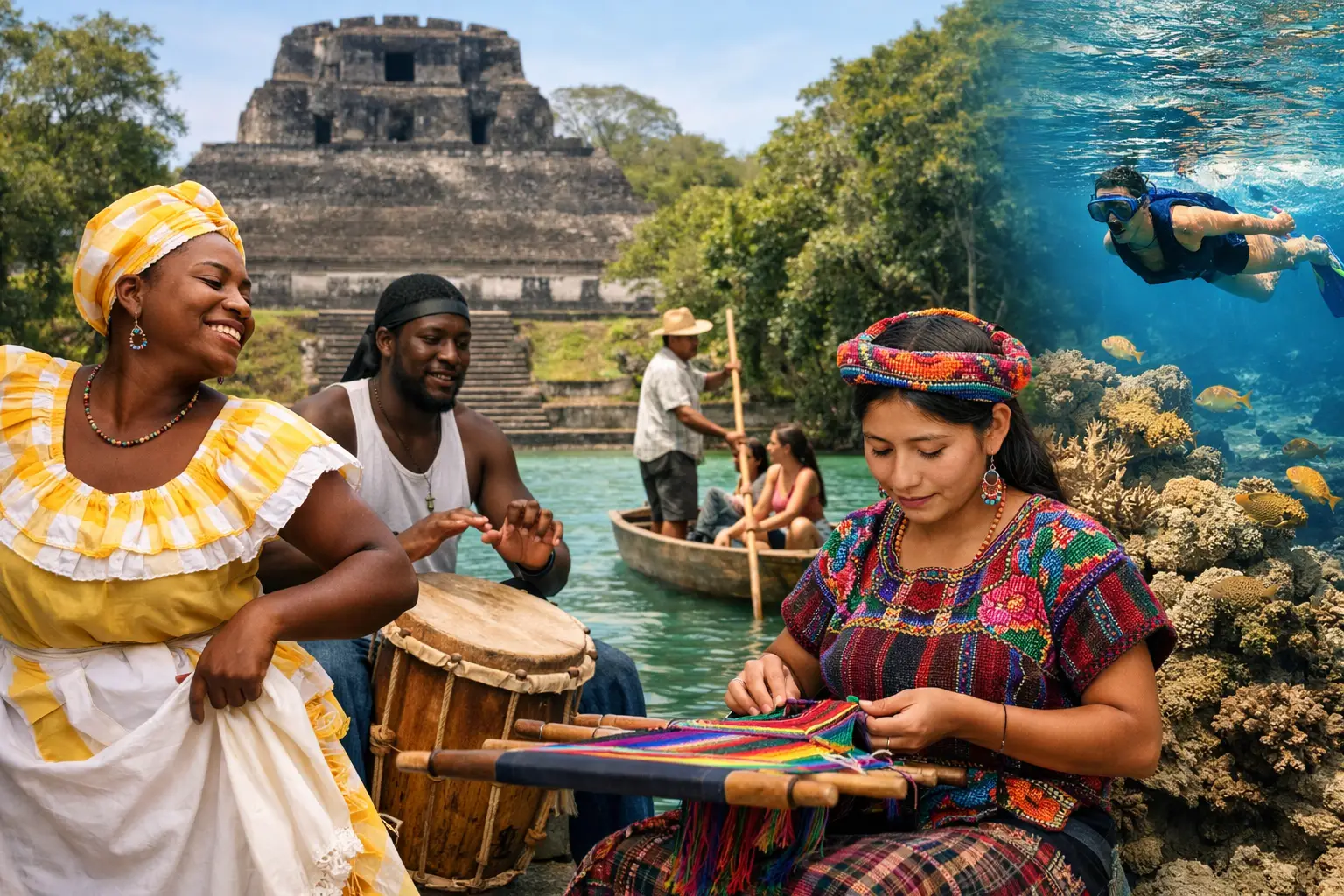
Belizean heritage is broader than the ancient Maya world, and a well-rounded trip should leave room for that. The country is shaped by Maya, Garifuna, Creole, Mestizo, and Mennonite communities, among others. Each contributes to Belize’s identity through language, music, cooking, farming traditions, and daily life.
You may not always encounter these traditions in a formal setting, and that is often a good thing. A roadside meal can reveal as much about heritage as a scheduled demonstration. A local conversation about cassava, cacao, corn, or recado tells you how food carries memory. Music, drumming, storytelling, and even the way communities organize family life all add layers to what visitors understand about Belize.
This is one reason private inland touring appeals to travelers who want substance. It creates more room to notice the small details that group tours often miss. You are not being hurried from stop to stop. You can ask why a dish is prepared a certain way, what a trail once connected, or how local families relate to a nearby site today. Those moments are simple, but they often become the ones people remember longest.
How to choose the right cultural experience in Belize
The right fit depends on what kind of traveler you are. If you are drawn to history, start with a Maya site and choose a guide who can explain more than dates and names. If you want movement and scenery along with cultural context, caves and river-based tours can be an excellent match. If your interest is broader, combine archaeology with food, village stops, or nature-based interpretation.
Pacing matters too. Some travelers want a full day with multiple elements. Others enjoy one focused experience with time to absorb it. There is no single best version of Belize cultural heritage experiences, only the version that fits your curiosity, comfort level, and travel style.
It also helps to think about crowds. A major site at a busy hour can still be worthwhile, but quieter routes often create a stronger sense of connection. That is especially true for couples, families, and small private groups who value conversation and flexibility. A guide who knows when to go, where to pause, and how to shape the day around your interests can make a familiar place feel personal.
Why private, locally guided experiences often feel more real
Heritage is personal, so the way you experience it should be personal too. That does not mean every cultural outing needs to be serious or academic. It means you benefit from being with someone who knows the place firsthand, understands the balance between adventure and interpretation, and can adjust the day to your pace.
That local connection is where trusted operators make a difference. A company like Belize Inland Tours can combine access to inland sites, practical logistics, and cultural context in a way that feels smooth without feeling scripted. For many visitors, that is the sweet spot – enough structure to feel comfortable, enough flexibility to stay curious.
There is also a safety piece that matters, especially in caves, on jungle trails, and around remote archaeological areas. Experienced local guides do more than lead the route. They read conditions, manage pacing, and help travelers feel at ease in places that might otherwise feel unfamiliar. That reassurance lets you stay present and enjoy the experience for what it is.
Belize cultural heritage experiences stay with you differently
Some trips are easy to enjoy and easy to forget. Cultural travel works differently when it is done well. It gives places weight. After a meaningful day inland, the jungle is no longer just green space, and a Maya site is no longer just a stop on an itinerary. You begin to understand Belize as a country shaped by continuity, adaptation, and strong local identity.
That is why the most rewarding experiences are rarely the loudest ones. They are the quiet moments in a forest plaza, the story shared beside a cave entrance, the meal that opens a conversation, the guide who helps you connect the past to the present. If you make room for those moments, Belize will give you far more than sightseeing. It will give you a sense of place that stays with you after the trip is over.


A Cultural Cave Interpretation Example In Belize – Belize Inland Tours
October 3, 2026 - 11:39 am[…] approach also gives travelers a better way to understand Maya heritage. The ancient Maya were not a vanished people frozen in the past. Maya communities remain part of […]