

 Uncategorized
The forest often announces the morning before the sun does. A distant keel-billed toucan calls from the canopy, a hummingbird flickers through a flowering shrub, and the trail is still cool beneath the trees. That quiet window is where how bird watching tours work becomes clear: the experience is less about rushing from one checklist species to another and more about slowing down with a guide who knows what the forest is saying.
In Belize, a bird watching tour is a guided walk or drive through habitats where birds are active, visible, and best understood in context. You may travel through broadleaf forest, open savanna, river edges, limestone hills, or the grounds around a national park. Your guide helps you notice movement, identify calls, find birds without disturbing them, and understand how each species fits into the larger landscape.
How Bird Watching Tours Work in Belize
Most tours begin early because birds are most active in the first hours after dawn. The air is cooler, the light is softer, and many species are feeding, calling, or moving through the lower and middle levels of the forest. An early meeting time can feel ambitious on vacation, but it is often the difference between hearing a forest come alive and walking through it after its busiest hours have passed.
After meeting your guide, the day starts with a short conversation about your interests and comfort level. Some guests are experienced birders with a species list in hand. Others simply want to see colorful tropical birds and learn what they are looking at. Both approaches work well. A private tour can move at the pace of the people in it, whether that means waiting patiently for a motmot to return to a branch or continuing down the trail to explore another habitat.
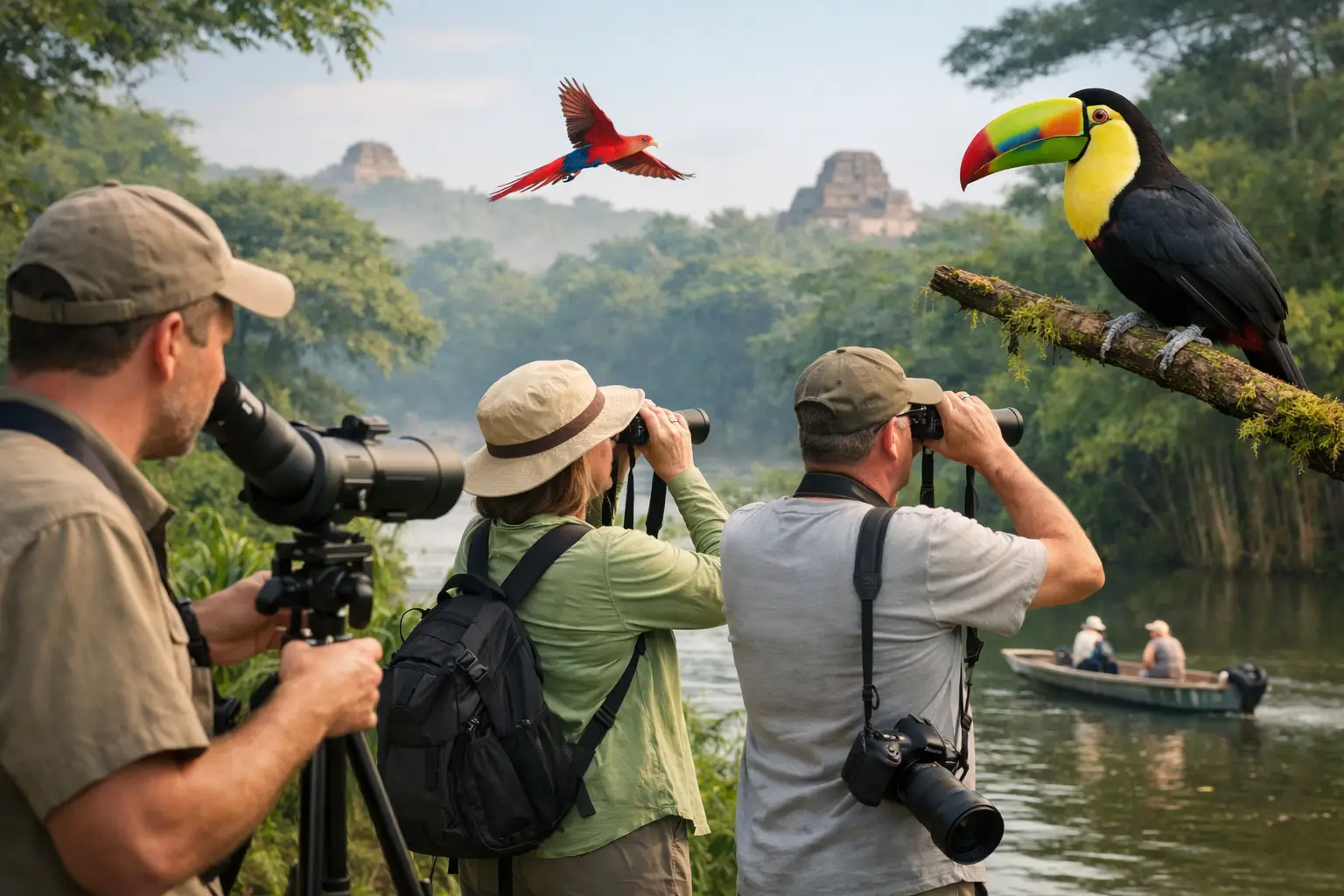
Your guide will usually carry binoculars and may use a field guide, spotting scope, or a bird call reference when appropriate. Guests are welcome to bring their own binoculars, but they do not need to arrive as experts. Learning to use binoculars comfortably is part of the experience. A good guide will point out where to look first, describe a bird’s position clearly, and give everyone time to get their eyes on it.
The route is selected for habitat, recent activity, weather, and the group’s goals. There is no promise that wildlife will appear on schedule. That is part of a real nature experience. But local knowledge improves the odds considerably. Guides recognize fruiting trees that attract toucans and aracaris, quiet forest edges where trogons may sit, and wet areas where herons, kingfishers, or wading birds are more likely to feed.
The Guide Does More Than Identify Birds
Bird watching is often described as a visual activity, but in the Belizean jungle, listening matters just as much. Dense vegetation can hide a bird that is only a few yards away. A guide may stop because of a short whistle, a rising song, wingbeats in the canopy, or the alarm calls of smaller birds responding to a predator.
That is why local guiding adds so much value. Your guide is not simply naming birds after they appear. They are reading the environment, interpreting behavior, and helping you understand what you are hearing and seeing. A black-headed trogon, for example, is more memorable when you know why it favors a shaded forest perch. A lineated woodpecker becomes more than a flash of black and red when you notice the sound of its work on a trunk.
The guide also helps keep the encounter respectful. Birds need space to feed, nest, and rest. Ethical bird watching avoids crowding wildlife, blocking a bird’s path, handling animals, or using calls in ways that cause repeated stress. In quieter inland settings, that respectful approach also creates better viewing. Less noise and fewer people often mean more natural behavior.
What a Typical Morning Feels Like
A bird watching tour is not usually a strenuous race through the jungle. It is a series of unhurried observations connected by easy walking, brief drives, and frequent pauses. One moment you may be looking high into the canopy for an oropendola nest. The next, you may be standing still beside a trail while a mixed flock moves through the trees.
Expect uneven ground in some areas, humidity, insects, and the possibility of rain, especially in the green season. Belize’s weather can change quickly, and a light shower does not necessarily end the outing. In fact, the cooler period after rain can bring renewed bird activity. Your guide will make practical decisions based on trail conditions and guest comfort, rather than forcing a rigid itinerary.
Private tours are especially useful for couples, families, and small groups because the day can be adjusted without waiting on a large bus schedule. If a child is fascinated by a butterfly, if one guest wants to photograph a bird carefully, or if everyone would rather take a slower route, there is room for that. Belize Inland Tours builds its private inland experiences around that kind of personal attention, with guides who know when to pause and when to lead the group toward the next promising area.
Birds You May See, and Why “May” Matters
Belize is home to an exceptional variety of birdlife, from bright forest species to birds of wetlands and open country. Depending on location and season, guests may encounter keel-billed toucans, Montezuma oropendolas, parrots, hummingbirds, motmots, trogons, flycatchers, woodpeckers, hawks, and colorful tanagers. Migratory birds add another layer during parts of the year.
Still, bird watching is not a zoo visit. A specific species cannot be guaranteed, even on a well-planned route. Wind, rain, breeding cycles, food sources, and simple chance affect what appears. The best tours set honest expectations: a successful morning is measured by quality of observation, time in good habitat, and the stories behind what you find, not only by a number on a checklist.
For serious birders, sharing a target list before the tour is helpful. A guide can then recommend the best timing, habitat, and realistic expectations. For first-time bird watchers, it is usually better to arrive curious rather than focused on spotting everything. The surprise of seeing a toucan glide across an opening or a tiny hummingbird hover at eye level is often stronger when you are fully present for it.
What to Bring and How to Prepare
Comfortable closed-toe shoes, lightweight long sleeves, insect repellent, sun protection, water, and a small rain layer are sensible for most inland birding outings. Neutral colors such as green, tan, gray, or brown are preferable to very bright clothing. They are not a magic solution, but they can help you feel less conspicuous in quieter habitat.
Bring binoculars if you have them, along with a camera if photography is part of your goal. A camera with a long lens can be rewarding, but it changes the pace of the day. Photographing birds takes patience, and it is worth telling your guide in advance if you want time for images rather than quick sightings. If you are new to binoculars, do not let unfamiliar equipment hold you back. Your eyes, ears, and guide’s direction are enough to begin.
It also helps to avoid strong perfume, loud phone alerts, and conversation that carries far down the trail. You do not need to remain silent for hours, but quieter movement gives birds less reason to disappear before the group arrives.
Safety, Comfort, and the Value of a Local Route
Belize’s inland environments are beautiful precisely because they are wild. Trails can be slick, roots can be hidden under leaves, and tropical heat can build quickly after midmorning. Guided tours provide a practical layer of safety through route knowledge, pacing, weather awareness, and attention to the needs of each guest.
The right setting depends on your interests. A first-time visitor may enjoy an accessible forest walk with plenty of opportunities to stop. A committed birder may prefer an earlier departure and a longer stretch through varied habitat. Families may want to combine bird watching with another gentle nature activity. There is no single best version of the tour, only the version that gives you enough time and quiet to connect with the place.
When the morning ends, you may remember a species name or add a new bird to a life list. More likely, you will remember the moment the guide asked everyone to stop, the forest held still for a second, and a bright bird appeared exactly where it belonged.

