

 Uncategorized
A temple platform rising above the jungle is not simply a good photo stop. It is evidence of a living civilization whose descendants remain part of Belize today. This guide to Maya ceremonial sites helps you visit with more context, choose ruins that fit your travel style, and experience the country’s inland heritage with the care it deserves.
Belize’s archaeological sites can feel wonderfully uncrowded compared with famous ruins elsewhere in the region. That quieter setting is a privilege. Give yourself time to listen to the forest, look beyond the largest pyramid, and let a knowledgeable local guide explain the details that stone alone cannot tell you.
What makes a Maya site ceremonial?
The phrase “ceremonial site” is useful, but it can oversimplify what you are seeing. Maya centers were active cities, not just religious monuments. They included homes, markets, reservoirs, elite residences, plazas, ball courts, tombs, and temple complexes. Ceremony was woven into civic life, political authority, farming cycles, astronomy, and family identity.
The high temples and formal plazas were often stages for major public events. Rulers performed rituals, marked calendar dates, honored ancestors, and reinforced their role within the community. In smaller rooms and courtyards, people also practiced household rituals that were no less meaningful to daily life.
That is why a good visit is about more than climbing steps. Look for the relationship between buildings: a plaza framed by temples, a staircase facing a central space, or a ball court positioned near administrative structures. The layout tells a story about how people gathered, governed, celebrated, and connected with the sacred landscape around them.
The Belize sites worth planning around
Belize has many Maya sites, and the right choice depends on where you are staying, how much driving you want to do, and whether you prefer a major archaeological center or a shorter cultural stop paired with a cave or jungle experience.
Caracol for scale and deep jungle setting
Caracol is Belize’s largest known Maya center and one of its most powerful experiences. Located within the Chiquibul Forest Reserve, it rewards travelers who want a full inland day. Its central temple, Caana, remains one of the tallest man-made structures in Belize, while the wider site reveals an extensive city of plazas, causeways, reservoirs, and residential groups.
Caracol is best for travelers who want the scale of a major ancient capital and do not mind a longer journey. The road and remote setting are part of the experience, but they also make professional planning valuable. A private guided visit gives you flexibility with departure time, pacing, weather, and stops along the way.
Xunantunich for a dramatic river crossing
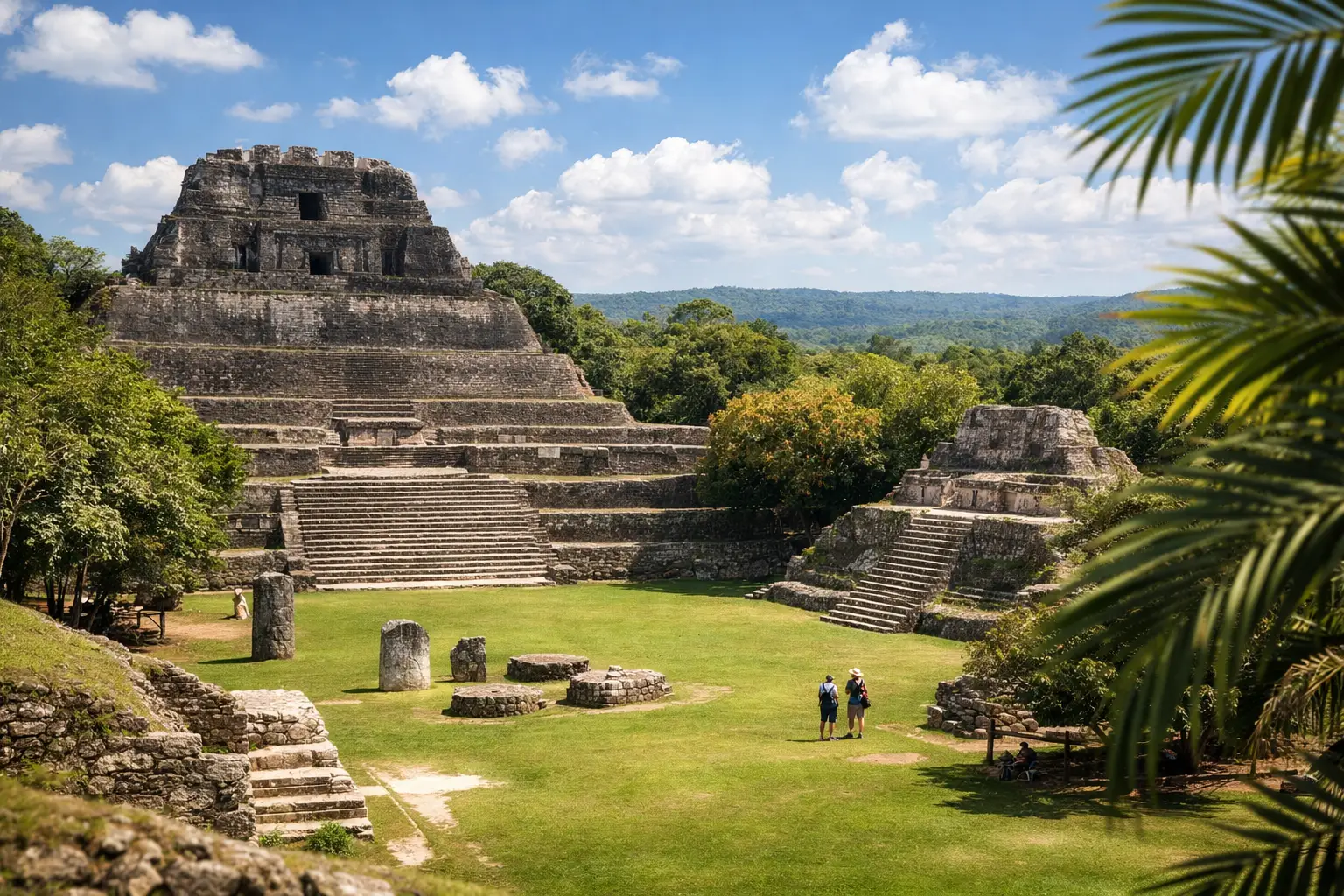
Xunantunich sits near the Guatemalan border and begins with a hand-cranked ferry crossing over the Mopan River. That small arrival ritual sets the tone before you even reach the ruins. El Castillo, the site’s main temple, rises above the surrounding countryside and is known for its carved friezes.
This is an excellent option for couples, families, and first-time ruin visitors because the site is impressive without requiring an all-day expedition. It also combines naturally with other western Belize experiences, including jungle drives, local villages, and selected cave adventures. Conditions and access can change with river levels, so a guide helps keep the day smooth and realistic.
Cahal Pech for an intimate hilltop visit
Cahal Pech is close to San Ignacio and feels more compact and personal than Caracol. Its palace groups, narrow passageways, and connected courtyards make it especially interesting for travelers who enjoy imagining how spaces were used. From its hilltop position, the site also offers broad views across the Belize River Valley.
Because it is relatively accessible, Cahal Pech works well when you have limited time or want to pair Maya history with another activity. It is not the place to chase the biggest pyramid in the country. It is the place to slow down and notice details: doorways, stairways, small plazas, and the way architecture created privacy as well as public display.
Lamanai for ruins reached by water
Lamanai is a distinct experience because the journey commonly includes travel along the New River Lagoon. The site sits in a rich wildlife area where howler monkeys, birds, and iguanas can be part of the day. Its name is often translated as “submerged crocodile,” fitting for a place so tied to water.
The river approach, forest setting, and substantial temples make Lamanai a strong choice for travelers who want culture and nature in one excursion. It can be a longer day from many parts of Belize, however. If your schedule is tight, choose a closer site rather than rushing through a long transfer and the ruins themselves.
Altun Ha for a straightforward northern option
Altun Ha is one of Belize’s best-known sites and a practical choice for visitors based near Belize City or the northern coast. It is associated with the famous jade head of Kinich Ahau, a powerful symbol of Belizean heritage. Its open plazas and recognizable temple structures make the site easy to understand visually.
Its accessibility can also mean more visitors, especially when cruise traffic is in the area. Timing matters here. An early start or a visit planned around local conditions can make the difference between simply seeing the site and having space to absorb it.
How to visit Maya ceremonial sites respectfully
Respect begins with language and expectations. These ruins are not abandoned curiosities from a vanished people. Maya communities and cultural traditions are present throughout Belize. Treat the sites as places of heritage, learning, and ongoing meaning.
Stay on designated paths, obey climbing rules, and never touch carvings, stucco, or exposed masonry. Oils from hands, repeated pressure, and casual scratching all contribute to damage over time. Do not remove pottery fragments, stones, seeds, or any other object, even if it appears loose on the ground. Archaeological context is what gives an object its meaning.
Dress for the environment rather than the photo. Closed-toe shoes with grip, light layers, a hat, water, insect repellent, and rain protection are sensible in Belize’s heat and changing weather. Temple stairs can be steep and uneven. Take your time, use rails where provided, and be honest with your guide about mobility concerns or your comfort with heights.
Photography is usually welcome in exterior areas, but rules may differ in museums, protected interiors, or temporary research zones. Ask before flying a drone. More importantly, keep your camera from becoming a barrier. Put it down occasionally and look at the architecture in relation to the hills, forest, and sky that shaped Maya life.
Why a local guide changes the experience
A sign can identify a building. A skilled guide can help you read it. They can point out how a structure was expanded over generations, explain why a plaza faces a particular direction, and place the city within the trade networks and rival kingdoms of the Maya world.
Local knowledge also adds practical value. Belize weather can change quickly, roads can be slow after rain, and the best route depends on your starting point and the kind of day you want. For private groups, a guide can balance archaeological interpretation with shade breaks, wildlife sightings, and the pace that works for your family or travel partner.
Belize Inland Tours approaches ruin visits as part of a larger inland experience, not a rushed checklist stop. The goal is to give you room for questions, safe movement through the landscape, and a more personal connection to the places you came to see.
Build a better day around the ruins
Avoid trying to fit several major sites into one day. You may cover more ground, but you will remember less. One significant ruin, a good lunch, and time for a nearby river, cave, or forest trail usually creates a far richer day than moving from parking lot to parking lot.
Morning is often the most comfortable time to walk exposed plazas, while late afternoon can bring softer light and a quieter feel. In the rainy season, flexible planning matters. Rain does not automatically ruin a ruin tour, but slick steps, muddy trails, and river conditions may alter the plan. A thoughtful guide will adjust for safety without stripping the day of its sense of adventure.
Leave the site with more than photographs. Notice the engineering behind reservoirs and terraces, the patience behind carved stone, and the fact that these centers were built in conversation with the Belizean landscape. When you visit with curiosity and respect, the jungle does not just frame the ruins. It helps you understand them.

