

 Uncategorized
A flash of red in a fruiting tree. A deep, rolling call from the canopy. A small bird that vanishes into the leaves before you can raise your binoculars. That is the daily rhythm of birding in Belize, where the jungle rarely gives up its secrets all at once. This guide to tropical bird identification helps you slow down, notice the right details, and enjoy the search without turning every walk into a test.
Belize sits between Central American forest, Caribbean coast, wetlands, and Maya Mountain foothills. That mix creates remarkable bird diversity in a relatively small country. You may see a bright keel-billed toucan near an open forest edge, then hear a trogon calling farther down the same trail. The best sightings often come from patience, a quiet group, and a guide who knows which sound belongs to which layer of the forest.
Start With Habitat, Not Just Color
In tropical forests, color can mislead you. Light changes beneath the canopy, birds move quickly, and a green parrot may blend into green leaves almost perfectly. Before trying to name a bird, take note of where it is.
A bird perched high in a sunlit tree may be feeding on fruit, scanning for insects, or calling across a clearing. A bird low in tangled vegetation is more likely to be a wren, antbird, or other understory species. Near water, watch for herons, kingfishers, swallows, and waterbirds. Open fields and forest edges are good places for flycatchers, kiskadees, and raptors.
Inland Belize offers a useful variety of habitats within a single day. Around trails near St. Herman’s Blue Hole National Park, mature forest, limestone features, streams, and clearings create different opportunities for birds to feed and shelter. A knowledgeable local guide reads these spaces first, then looks for the species most likely to be using them.
Learn the Main Bird Shapes First
You do not need to memorize every tropical species before your trip. Begin by recognizing broad families. This is faster, more enjoyable, and far more useful when a bird appears for only a few seconds.
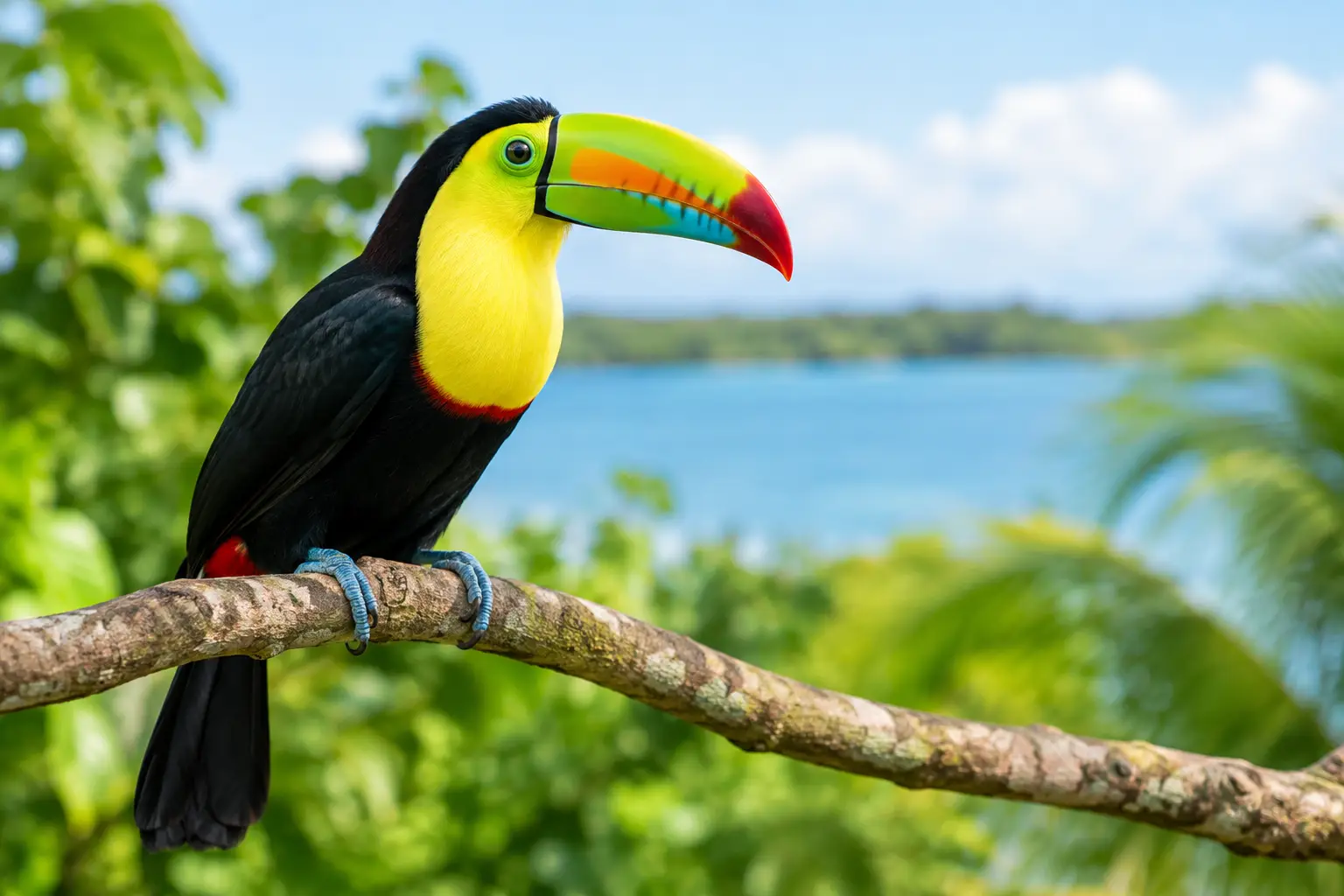
Toucans are large and unmistakable once you notice the oversized bill and long body. The keel-billed toucan, Belize’s national bird, has a colorful bill, bright throat, and bold black-and-yellow pattern. Aracaris are smaller toucan relatives, often seen moving through fruiting trees in active groups.
Parrots and parakeets have strong hooked bills, compact bodies, and direct flight. Their calls often reveal them before their color does. Look for a fast-moving flock above the canopy, then listen for sharp, repeated screeches as they pass overhead.
Trogons sit quietly on horizontal branches and can seem almost unreal when sunlight reaches their red, yellow, or green plumage. They usually have a heavy-headed profile and a patient posture. Motmots also favor shaded forest, but their long tails, often ending in racket-shaped tips, help separate them from other medium-sized birds.
For small birds, focus on behavior before tiny field marks. Warblers flick through leaves. Flycatchers perch upright, make quick flights to catch insects, and return to a branch. Hummingbirds hover, but they may also perch surprisingly still between feeding visits.
A Practical Guide to Tropical Bird Identification
When you spot a bird, try to remember four things: size, shape, behavior, and sound. Color comes after that. A yellow bird could be several species, but a yellow bird with a heavy bill, a slow hop, and a low whistle gives you a much clearer starting point.
Size is easiest when you compare the bird with something familiar. Is it sparrow-sized, robin-sized, or closer to a crow? Shape includes the bill, tail, wings, and posture. A long curved bill may suggest a hummingbird or a woodcreeper, while a thick cone-shaped bill can point toward a seedeater or finch.
Behavior is one of the strongest clues in the tropics. Woodpeckers climb trunks. Oropendolas travel in noisy groups and build long hanging nests. Jacamars wait quietly before darting after insects. Manakins may make quick, energetic movements in the understory during display season.
Sound matters just as much. Many jungle birds are heard far more often than they are seen. Do not worry if you cannot identify every call at first. Start by noticing its pattern. Is it a whistle, a chatter, a repeated knock, or a long descending phrase? A guide can help connect that sound to a species, and after a few walks you may begin recognizing familiar voices on your own.
Birds You May Encounter in Belize’s Inland Forests
The keel-billed toucan earns plenty of attention, and rightly so, but it is not the only memorable forest bird. Collared aracaris may appear in small groups, their calls carrying through the canopy. Montezuma oropendolas are often easier to hear than see, especially near their dramatic hanging nests. Their bubbling calls are part of the soundscape around forest edges.
Look and listen for the violaceous trogon, a handsome bird that favors woodland and forest. Its steady call may lead you to a perch above the trail. The turquoise-browed motmot, with its bright blue eyebrow and distinctive tail, is another rewarding sight around more open woodland and clearings.
Belize’s raptors require a different approach. Hawks, kites, and vultures may circle above open areas, but forest raptors are often brief, silent encounters. Watch for a broad-winged silhouette, a sudden movement through the canopy, or alarm calls from smaller birds. A distant bird of prey should not be named with confidence unless key features are clear. Sometimes “small raptor, likely a hawk” is the most honest identification.
Season also changes what you may see. Resident tropical birds can be present year-round, while migratory species from North America add variety during the cooler months. A birdwatching walk in Belize is never exactly the same twice, even on the same trail.
Use Your Ears and Move More Slowly
The urge to keep walking is understandable. Belize’s caves, trails, and Maya sites offer a lot to see. Yet birds often appear when the group pauses. Stop near a fruiting tree, a flowering shrub, or a quiet water crossing. Let the forest settle after your footsteps.
Avoid playing bird calls from a phone. Repeated playback can stress birds, interrupt feeding or nesting behavior, and draw them away from natural activity. It may also spoil the quiet experience for other visitors. Listening carefully is more rewarding than trying to force a sighting.
Morning is usually the most productive time, especially soon after first light. Birds are feeding, calling, and moving before the heat builds. Late afternoon can also be excellent, although forest light fades quickly. Rain does not end bird activity, but heavy downpours can make both listening and visibility more difficult.
Bring the Right Gear, but Keep It Simple
A pair of binoculars is the most helpful tool for bird identification. For many travelers, 8×42 binoculars offer a comfortable balance of magnification, brightness, and steadiness in low forest light. Higher magnification can be useful in open country, but it is harder to hold steady when a bird is moving through dense leaves.
Wear neutral-colored clothing and closed-toe shoes suitable for uneven trails. A light rain jacket, water, insect protection, and a small notebook or phone for observations are sensible additions. Keep your camera ready, but do not let photography replace looking. Some of the best sightings last only moments and are better remembered as an experience than chased as a perfect image.
A bird guide or identification app can be useful after the walk, when you have time to compare notes. In the moment, it is usually better to watch, listen, and ask questions. A private outing gives you room to do that without being rushed by a large group or a fixed timetable.
Let Local Knowledge Fill the Gaps
Tropical bird identification has its limits. Females, juveniles, and birds in poor light can look very different from field-guide illustrations. Some species are nearly identical at a distance. There is no shame in leaving a bird unidentified, especially if you only caught a silhouette.
That is where experienced local guidance adds real value. A guide may recognize a call before the bird appears, know which trees are fruiting, or notice a nest tucked high above the trail. At Belize Inland Tours, bird sightings are part of the wider inland experience – the pause before entering a cave, the call from the trees during a jungle hike, or the unexpected color beside a quiet trail.
Keep your binoculars close, your voice low, and your expectations open. The bird you hoped to see may stay hidden, but the forest will usually offer something else worth stopping for.
